|
Listen to the Article Here
|
Does Posting More Often Increase Social Media Reach?
What the Data Shows
Your team creates a useful post, publishes it, and moves on. A few people react. Some visit your profile. Then the post disappears into a busy feed.
Does that mean the content failed? Not necessarily. Many potential customers may never have encountered it.
Publishing more frequently gives your business additional opportunities to reach people, answer questions, and learn which messages connect. But frequency works best when it is supported by useful content and a clear business objective.
Posting more often can increase social media reach by creating more opportunities for discovery, audience engagement, and learning. Research supports testing a higher cadence, but results depend on content quality, platform, audience, and execution.
The goal is to build a publishing schedule your team can sustain and your audience has a reason to follow.
Why One Post Is Rarely Enough
Publishing a message does not mean your entire audience has seen it.
People use social platforms at different times, follow many accounts, and encounter content selected for their interests. A customer who misses your project video might discover your business through a checklist or an answer to a common question several days later.
That makes consistent publishing valuable. Each useful post creates another opportunity to connect.
However, there is no universal percentage of followers who will see a post. Reach varies across platforms, accounts, formats, and individual pieces of content.
Instead of assuming one announcement has reached everyone, communicate important ideas through different examples and formats over time.
What Does the Research Say About Posting Frequency?
Instagram: A Moderate Increase Can Be Meaningful
Buffer analyzed more than 2 million posts from over 100,000 Instagram accounts. Its analysis associated posting three to five times per week with approximately 12% higher reach per post compared with posting once or twice weekly.
The study covered feed content, including photos, Reels, and carousels. It did not include Stories. Higher posting frequencies were associated with further gains, but the incremental improvements became smaller. Buffer’s Instagram posting-frequency research
For a business publishing sporadically, that supports testing a manageable increase before attempting daily or multiple-daily production.
LinkedIn: More Opportunities to Join the Conversation
Buffer also analyzed more than 2 million posts from over 94,000 LinkedIn accounts. It identified two to five posts per week as a practical starting range and reported stronger per-post performance than posting once weekly.
Its methods included comparing accounts with their own performance over time and controlling for account-level differences. Buffer’s LinkedIn posting-frequency research
These are observational findings from accounts represented in Buffer’s data. They are not randomized experiments or promises that your company will achieve the same improvement.
They provide a useful reason to test frequency, not a reason to abandon judgment.
Four Ways Posting More Frequently Can Expand Your Reach
1. Each Post Creates Another Opportunity for Discovery
Different topics can attract different people. A project example may interest someone evaluating providers, while an educational video reaches someone just beginning to understand a problem.
Consider a commercial contractor publishing:
- A short explanation of project scheduling.
- Photos from a completed renovation.
- A checklist for preparing an occupied building for work.
- An answer to a common budgeting question.
Each post gives a different audience member a reason to pay attention.
However, audiences overlap. Ten posts reaching 500 accounts each do not necessarily equal 5,000 different people. Some people may see several posts.
2. Useful Content Has More Opportunities to Earn Distribution
Meta explains that its systems use multiple signals and predictions to rank content, including whether someone is likely to find it relevant or interact with it. Recommended content can also come from accounts a person does not follow. Meta’s explanation of Facebook and Instagram ranking
Publishing more gives your business additional content that could earn those responses.
That does not mean an account automatically receives a reach bonus for staying busy. Frequency alone does not establish relevance, and a calendar full of weak posts will not reliably compensate for an unclear message.
Give each post a purpose: answer a question, demonstrate expertise, explain a decision, or help someone take a useful next step.
3. Repeated Exposure Can Build Familiarity
Customers may encounter your business before they are ready to buy.
A manufacturer might publish technical explanations for months before a buyer has a sourcing requirement. A real estate professional may share local insights well before a homeowner decides to sell.
A consistent presence gives people more opportunities to recognize your name and understand what you do.
Familiarity is not the same as trust. Trust requires credible information, evidence, and a customer experience that supports your promises.
Repeat your core expertise through different examples rather than publishing the same sales message repeatedly.
4. A Steady Schedule Creates More Learning Opportunities
If you publish four times a month, you have relatively few opportunities to explore topics and formats.
A more frequent schedule can help you compare:
- Customer questions and objections.
- Short videos, graphics, and written posts.
- Educational content and project examples.
- Different opening lines.
- Different calls to action.
More posts do not automatically produce reliable conclusions. A small account may still need several weeks to identify useful patterns.
Keep notes on what changed. Otherwise, you may increase output without learning why one post worked better than another.
Reach, Impressions, and Leads Are Different Results
Before increasing frequency, decide what you want to improve.
- Reach generally describes the number of unique accounts exposed to content within the platform’s reporting scope.
- Impressions count displays, which may include repeated exposure to the same person.
- Video views follow platform-specific definitions and should not automatically be treated as unique viewers.
- Leads are people who express interest in your business. Qualified leads also fit your service, location, budget, or other relevant requirements.
A hypothetical example illustrates the difference: one post produces 1,000 impressions. Four posts produce 700 impressions each, totaling 2,800. Total impressions increased even though impressions per post declined.
That does not establish how many unique people were reached or whether more customers resulted.
Review both overall performance and efficiency. If production costs double, a modest increase in visibility may not justify the additional work.
How Often Should a Business Post on Social Media?
Use a starting schedule, then adjust it based on results and capacity.
Platform | Suggested starting cadence | How to use it |
|---|---|---|
| 3 to 5 feed posts per week | Test a mix of Reels, carousels, and images. Use Stories when you have relevant updates. | |
| 2 to 5 posts per week | Publish useful insights, customer questions, project lessons, and evidence of expertise. | |
| 3 to 5 posts per week | Start with helpful information, local relevance, and business updates. Adjust to audience response. | |
| TikTok | 2 to 5 videos per week | Build a repeatable production process before attempting multiple daily uploads. |
| X | 1 to 3 original posts per day, if relevant | Treat this as an optional test for businesses whose audience participates there. Include time for conversation. |
The Instagram and LinkedIn ranges reflect the research above. Buffer’s TikTok research also identifies two to five weekly posts as an efficient starting range. The Facebook and X ranges are practical testing suggestions, not proven optima for every business. Buffer’s TikTok research
You do not need to adopt every row. Choose the platforms that fit your audience and the formats your team can produce well.
If your business currently posts once a month, establish a reliable weekly schedule first. Increase the frequency as your content process and capacity improve.
How to Publish More Without Creating Everything From Scratch
A sustainable content plan begins with reusable expertise.
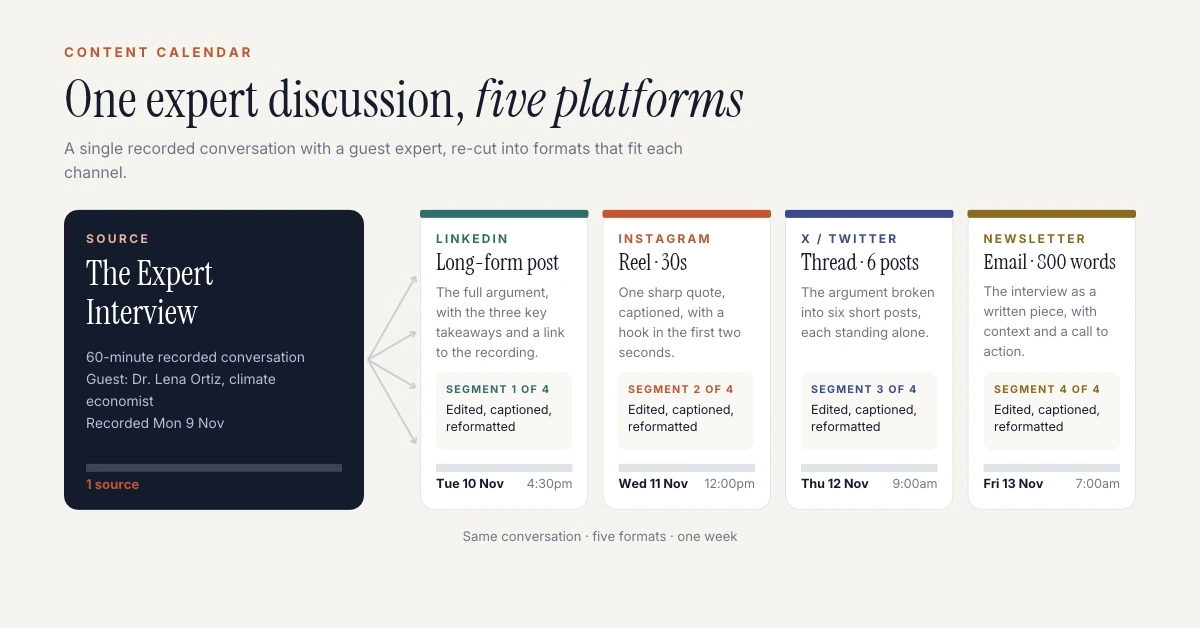
Record a short conversation with an owner, project manager, specialist, or salesperson. Ask them to explain a customer problem they understand well.
For example, a discussion about preparing for a commercial renovation could become:
- A short video answering one planning question.
- A carousel outlining preparation steps.
- A LinkedIn post explaining a common mistake.
- A Facebook post showing a relevant project.
- A website FAQ or longer article.
Adapt each piece to its destination. Give it a suitable opening, useful context, readable visuals, and a clear purpose.
Repurposing should make the material useful in another format. Simply publishing identical wording everywhere may miss how audiences use each platform.
Build Around Questions Customers Already Ask
Your sales and customer service teams can provide a steady supply of relevant topics.
What do prospects ask before requesting a quote? What misunderstandings delay decisions? What do customers wish they had known before starting a project?
Turn those questions into a content library. This reduces the pressure to invent new ideas while keeping your publishing connected to actual customer needs.
When Posting More Can Work Against You
Increase frequency only while maintaining a reasonable quality standard.
Warning signs include:
- Content becoming repetitive or less specific.
- Unfollows or negative feedback increasing.
- Comments and inquiries going unanswered.
- Production taking time away from customer service.
- More views arriving without relevant website activity or inquiries.
- The team publishing claims it has not checked.
Before scheduling a post, ask:
Who is this for, what does it help them understand, and why should they care?
If those answers are unclear, improve the content before adding another publishing slot.
A Practical Six-Week Posting Test
Establish Your Baseline
Review several recent weeks of posting frequency, account-level reach where available, engagement, website activity, and qualified inquiries.
Separate organic performance from paid promotion when the reporting allows it.
Increase Frequency Gradually
For example, move from one weekly post to three. Choose a schedule your team can maintain for six weeks.
Avoid simultaneously changing your audience, content strategy, paid budget, and posting volume. Too many changes make results harder to interpret.
Keep a Consistent Content Mix
Use a repeatable combination of customer education, proof of work, business perspective, and relevant offers.
Reserve time to respond to comments and messages.
Evaluate the Full Outcome
Compare total visibility, typical per-post performance, qualified inquiries, and production effort. Record unusual events such as a major promotion, seasonal demand, or a breakout post.
Six weeks is a practical review point, not a guarantee of statistical certainty or enough time to assess a long sales cycle.
Keep the higher cadence if it improves meaningful results at a sustainable cost. Refine it if additional output mainly creates additional work.

Turn Consistent Content Into Business Opportunities
Publishing more useful content can help your business become easier to discover and more familiar to prospective customers. The strongest results come from connecting that content to your audience, website, offers, and follow-up process.
Digital Marketing Partner’s social media management services can help your business develop and maintain a more consistent social presence.
Whether you need a workable posting schedule, stronger content, or support with ongoing execution, start with the customers you want to reach and the outcomes you want to improve.
Email [email protected] or visit Digital Marketing Partner to discuss your social media goals.
Tell us where you currently post, how often you publish, and what you want your content to accomplish.
Frequently Asked Questions
Editorial source note: This article also draws on the supplied transcript of Alex Hormozi’s “They Upload 100 Times A Day…” as commentary on content volume and audience exposure. Quantitative findings are attributed to the linked research.